
DAY 1: Arrival in Arusha — The Beginning of the Journey
Arrival at Kilimanjaro International Airport and transfer to Arusha. The JUA EXPLORER team will be waiting — a warm, professional welcome that sets the tone for the days ahead. Your guide conducts a full briefing over dinner, explaining the route, the parks, and what each day holds in store. Overnight in Arusha.
DAY 2: Lake Manyara National Park — Forest, Flamingo, and First Encounters
The first full safari day begins with a westward drive from Arusha, descending into the Great Rift Valley and entering Lake Manyara through its dense forested entrance. The transition from the open road to the closed canopy of the groundwater forest is immediate and immersive — the temperature drops, the light filters green, and the sounds of Arusha's traffic are replaced entirely by birdcall and the movement of animals through undergrowth.
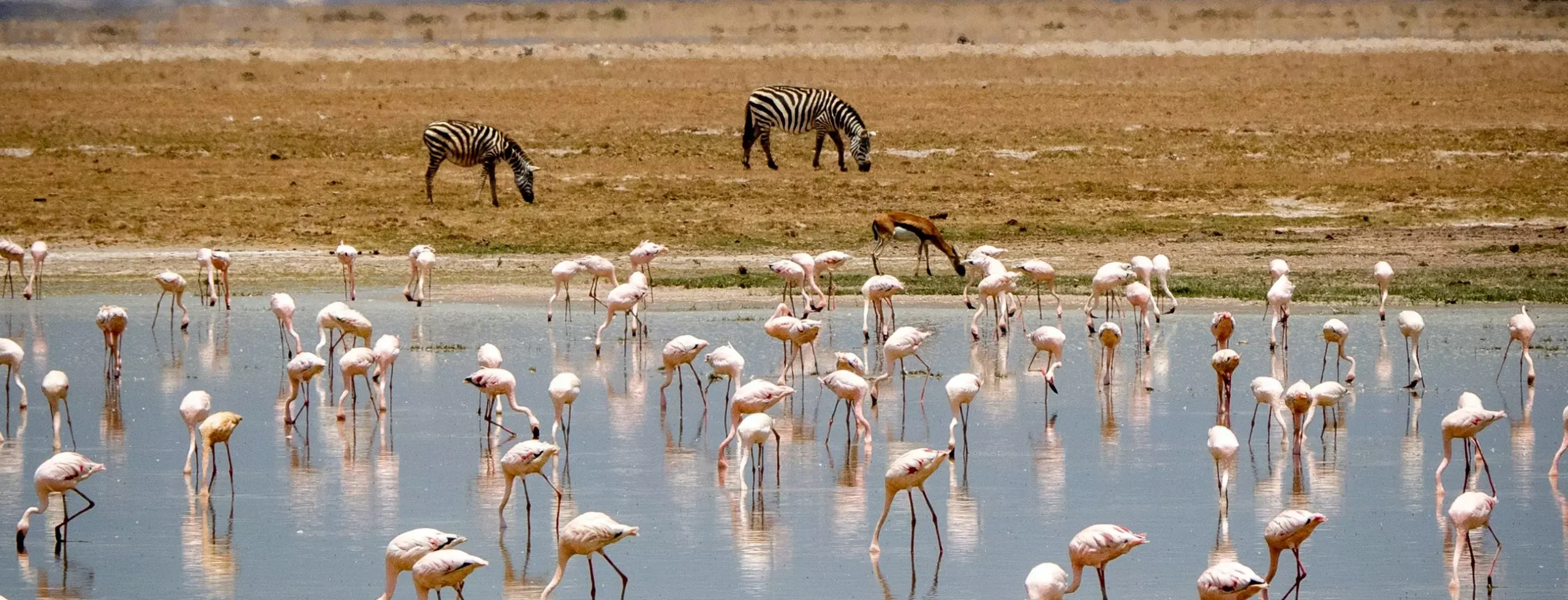
Lake Manyara's compact geography conceals extraordinary ecological diversity. Within its boundaries exist at least six distinct vegetation zones, each supporting its own suite of species. The alkaline lake itself — fed by underground springs and the outflow from the crater highlands above — provides critical habitat for one of Tanzania's most spectacular waterbird assemblages. The flamingo concentrations here can number in the hundreds of thousands during favourable conditions, the pink of their plumage reflected in the still water creating one of East Africa's most iconic wildlife images.
Your guide will spend the day moving thoughtfully through the park's zones, allocating time to the most productive areas and responding to fresh sightings with experience and local knowledge. Tree-climbing lions remain one of Manyara's defining wildlife encounters — the park's lion prides have been documented resting in the branches of fever trees for generations, and your guide knows the territories and the habits of these individuals well. Overnight in a lodge above the Rift Valley escarpment.
DAY 3: Ngorongoro Crater — Descent into the Caldera
From the Manyara escarpment, the road climbs into the Ngorongoro Conservation Area — a UNESCO World Heritage Site and Biosphere Reserve that encompasses not only the famous crater but an extraordinary mosaic of highland forest, open moorland, and Maasai pastoral land. The journey to the crater rim passes through communities of Maasai herders moving their cattle across the highland plateau, a reminder that this is a landscape shared between wildlife and people.
The descent into the crater is made in the morning light, when the floor below is still partly in shadow and the first game drive hour is rich with predator activity. Your guide will navigate the crater's zones with deliberate strategy: beginning in the areas most likely to produce predator sightings in the early morning, moving to the hippo pool and flamingo lake as the day warms, and spending the afternoon in the acacia woodland zones where leopard are occasionally found. A full day inside the crater with a picnic lunch and ascent to the rim for overnight.

DAYS 4 & 5: Serengeti National Park — Into the Great Plains
Crossing the Ngorongoro highlands and descending onto the Serengeti plains is one of Tanzania's defining safari transitions. The landscape changes with compelling speed: the highland moorland gives way to open short-grass savannah, and within minutes of entering the Serengeti, the wildlife is present in unmistakable abundance. The Serengeti is not merely a park — it is an ecosystem of planetary significance, one of the last places on Earth where the great mammal migrations that once characterised much of the world's grasslands continue uninterrupted.
Two full days in the Serengeti allow your guide to respond to conditions rather than follow a fixed route. If fresh lion tracks suggest a pride heading to a kill, the vehicle follows. If a cheetah is spotted on a termite mound surveying the open plains, time is spent in her company until she moves. This responsiveness — the willingness to let the wildlife set the agenda — is the defining quality of an expert safari guide, and it is precisely how JUA EXPLORER's guides operate.
The Serengeti's Great Migration is the world's largest overland movement of animals: 1.5 million wildebeest, 300,000 zebras, and hundreds of thousands of Thomson's and Grant's gazelles circling through the ecosystem in a continuous annual cycle driven by rainfall and grass growth. Depending on your travel timing, you may encounter the herds calving on the southern plains, resting in the central Seronera area, or staging dramatic crossings of the Mara River in the north. Your guide will position the safari optimally for the season. Overnight in a tented camp.
DAY 6: Lake Natron — The Remote Shore
Lake Natron is not a park in the conventional sense. It is not managed for tourism, not signed, not crowded. It is simply one of Tanzania's most extraordinary natural environments — a vast, shallow alkaline lake lying at the foot of the active Ol Doinyo Lengai volcano in the northern Rift Valley, its waters coloured an intense brick-red by the salt-tolerant cyanobacteria that thrive in its extreme chemistry.
The lake is most famous as the breeding ground of the lesser flamingo — one of the largest flamingo populations in Africa nests here annually, drawn by the combination of the lake's chemistry and its remote inaccessibility. The volcanic landscape surrounding the lake is dramatic: black lava fields, hot springs steaming at the shoreline, and the imposing cone of Lengai rising above the rift wall. This is Tanzania at its most geological and most primal.
A walk to the Engare Sero waterfall — where a cool, clear river tumbles through ancient volcanic rock to meet the lake's edge — provides a moment of startling natural beauty in a landscape otherwise dominated by heat and alkalinity. The footprints preserved in ancient ash near the lakeshore are estimated to be approximately 19,000 years old — some of the earliest evidence of modern human movement recorded in East Africa. Overnight near Lake Natron.
DAY 7: Tarangire National Park — The Final Safari
The return arc of the Tembea itinerary passes through Tarangire — a park of deep, quiet beauty that provides the perfect penultimate chapter. After the drama of Natron's volcanic landscape and the immensity of the Serengeti, Tarangire's intimate atmosphere feels almost contemplative. The ancient baobabs, the elephants moving at their unhurried pace, the late afternoon light catching the Tarangire River — these are images that settle gently into memory and stay there.
A final game drive in the late afternoon, as the light turns amber and the heat of the day releases, is one of the finest safari experiences in the Northern Circuit. Following the drive, you return to Arusha for your final overnight before the island portion of the journey begins.

DAY 8: Zanzibar — The Spice Island Escape
Crossing the Ngorongoro highlands and descending onto the Serengeti plains is one of Tanzania's defining safari transitions. The landscape changes with compelling speed: the highland moorland gives way to open short-grass savannah, and within minutes of entering the Serengeti, the wildlife is present in unmistakable abundance. The Serengeti is not merely a park — it is an ecosystem of planetary significance, one of the last places on Earth where the great mammal migrations that once characterised much of the world's grasslands continue uninterrupted.
Two full days in the Serengeti allow your guide to respond to conditions rather than follow a fixed route. If fresh lion tracks suggest a pride heading to a kill, the vehicle follows. If a cheetah is spotted on a termite mound surveying the open plains, time is spent in her company until she moves. This responsiveness — the willingness to let the wildlife set the agenda — is the defining quality of an expert safari guide, and it is precisely how JUA EXPLORER's guides operate.
The Serengeti's Great Migration is the world's largest overland movement of animals: 1.5 million wildebeest, 300,000 zebras, and hundreds of thousands of Thomson's and Grant's gazelles circling through the ecosystem in a continuous annual cycle driven by rainfall and grass growth. Depending on your travel timing, you may encounter the herds calving on the southern plains, resting in the central Seronera area, or staging dramatic crossings of the Mara River in the north. Your guide will position the safari optimally for the season. Overnight in a tented camp.